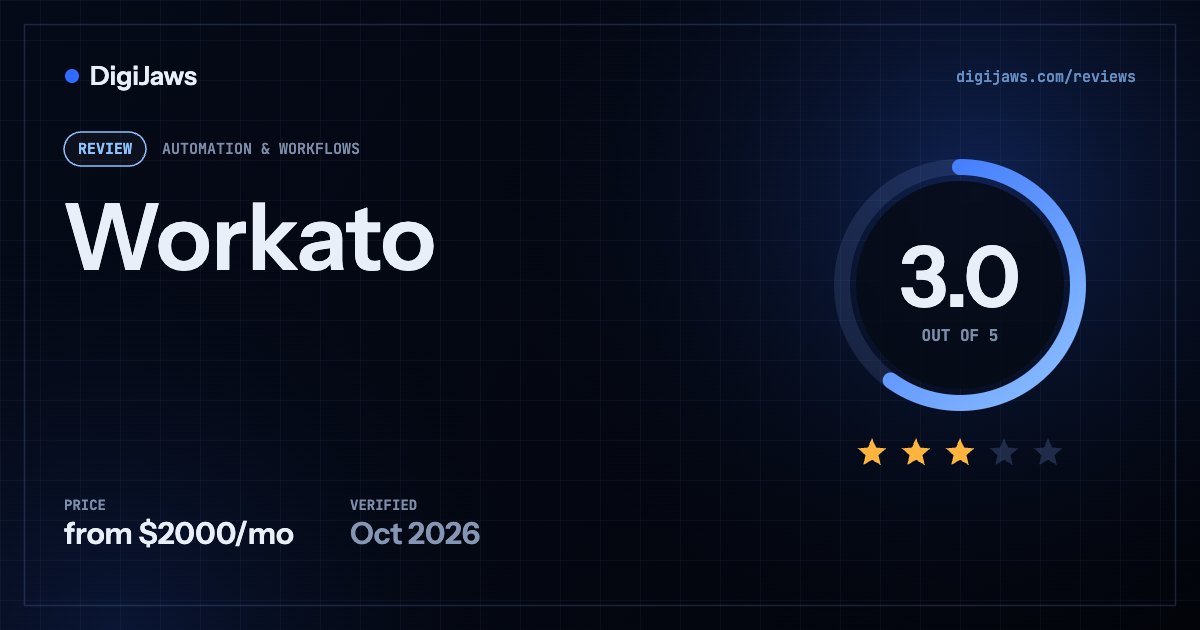
Workato — Serious enterprise integration depth, sold entirely by quote — where the starting plan is reported at $2,000 a month for 20 recipes.
Short answer: Workato is an enterprise integration platform sold on custom quotes with no public pricing. Reported figures put the Base Workspace at around $10,000 a year, with a starting plan at $2,000 a month billed annually including 50,000 workload units, 20 recipes, 10 users and business-hours support. Mid-market deployments are reported at $25,000-$50,000 a year, enterprise deployments with 200+ recipes at $75,000-$150,000, and multi-year contracts at 15-25% discounts.
On this page
Verdict at a glance
Connector depth and reliability at enterprise scale. Workato integrates systems that lighter platforms cannot reach, with the governance large organisations require.
The reported $2,000 monthly starting plan includes just 20 recipes and 10 users, with extra charges for recipe packs, premium connectors, high-volume recipes, on-premise access and additional seats.
Workato is a genuinely capable enterprise integration platform and one whose cost bears no relation to anything else in this comparison. It connects systems that lighter tools cannot reach, with the reliability, governance and audit capability large organisations require, and for a business integrating ERP, HRIS, finance and CRM across an enterprise estate that depth is the reason it wins. None of it is publicly priced. Reported figures put the Base Workspace at around $10,000 a year, with a starting plan at $2,000 a month billed annually including 50,000 workload units, 20 recipes, 10 users, business-hours support and basic security features. Mid-market deployments of 500 to 2,000 employees are reported at $50,000 to $130,000 annually, with other estimates putting mid-market at $25,000 to $50,000 and enterprise deployments running 200 or more recipes at $75,000 to $150,000. Multi-year contracts are reported to yield 15 to 25 per cent discounts. The detail that matters is what the starting plan excludes: additional charges apply for recipe packs, premium connectors, high-volume recipes, on-premise access and extra seats. Twenty recipes and ten users is a small deployment for a reported $24,000 a year, and most organisations buying Workato will exceed both quickly. Workato publishes no pricing, so that figure comes from third-party reports rather than from the vendor.
Quick facts
| Attribute | Detail |
|---|---|
| Ideal team | Enterprises integrating complex systems across a large estate |
| Learning curve | High — a genuine integration platform requiring expertise |
| Setup time | Weeks to months with implementation support |
| Free trial | Demo-led; ⚠️ no free tier |
| Free tier | None |
| Pricing published | ⚠️ No — quote only |
| Reported starting plan | $2,000/month billed annually, 20 recipes, 10 users |
| Key limit | ⚠️ Recipe packs, premium connectors and seats all cost extra |
Overview
Workato is an enterprise integration platform — an iPaaS in the traditional sense — built to connect complex systems reliably across a large organisation. Its strength is connector depth and the governance surrounding it: ERP, HRIS, finance and CRM systems that lighter automation tools cannot reach, integrated with the audit trails, error handling and operational visibility that enterprises require. For that job it is genuinely good, and the reason it commands the prices it does.
Nothing is publicly priced; Workato does not provide public pricing and requires a custom quote from its sales team. Reported figures place the Base Workspace at around $10,000 a year, with the starting plan at $2,000 a month billed annually and including 50,000 workload units a month, 20 recipes, 10 users, standard business-hours support and basic security features. Reported deployment costs vary widely by scale: mid-market companies of 500 to 2,000 employees are described at $50,000 to $130,000 annually in one account and $25,000 to $50,000 in another, while enterprise deployments running 200 or more recipes are reported at $75,000 to $150,000 a year.
The pricing model is structured around task consumption — the number of automated actions executed — connector access, and platform tier. What the starting plan does not include is the point worth emphasising: additional charges apply for recipe packs, premium connectors, high-volume recipes, on-premise access and extra seats. Twenty recipes and ten users is a modest deployment for a reported $24,000 a year, and any organisation with an integration estate large enough to justify Workato will exceed both allowances quickly. Multi-year contracts are reported to yield 15 to 25 per cent discounts, which suggests meaningful negotiating room. Establish the full configuration — recipes, connectors, seats, on-premise access — before comparing any Workato quote against an alternative.
Key features
- Enterprise connector depth⭐ reaches systems lighter tools cannot
- Recipesthe automation unit, ⚠️ 20 on the reported starting plan
- Workload units50,000 monthly on the reported starting plan
- Governance and auditenterprise operational requirements
- Premium connectors⚠️ charged in addition to the plan
- On-premise access⚠️ charged in addition
- High-volume recipes⚠️ charged in addition
- Recipe packs⚠️ charged in addition
- Business-hours supportstandard on the starting plan
- Multi-year discountsreported at 15-25%
Pricing (as of 2026-10-12)
Model: quote-only, structured on task consumption, connector access and platform tier · Free tier: ⚠️ none · Entry paid: Quote only — reported $2,000/month billed annually
| Plan | Price | Includes |
|---|---|---|
| Base Workspace | ⚠️ Reported ~$10,000 a year | The reported entry point for a Workato workspace |
| Starting plan | ⚠️ Reported $2,000/month billed annually | 50,000 workload units a month · 20 recipes · 10 users · standard business-hours support · basic security features |
| Mid-market | ⚠️ Reported $25,000-$130,000 a year | Sources differ: one reports $25,000-$50,000, another $50,000-$130,000 for companies of 500-2,000 employees |
| Enterprise | ⚠️ Reported $75,000-$150,000 a year | For deployments running 200 or more recipes |
| Additional charges | ⚠️ On top of any plan | Recipe packs · premium connectors · high-volume recipes · on-premise access · extra seats |
⚠️ Workato publishes no pricing and requires a custom quote. All figures here are third-party reported and differ between sources — mid-market is described at both $25,000-$50,000 and $50,000-$130,000 a year, which are not reconcilable. Treat them as ranges rather than quotes.
⚠️ The reported $2,000 monthly starting plan includes only 20 recipes and 10 users. Additional charges apply for recipe packs, premium connectors, high-volume recipes, on-premise access and extra seats — so the plan price is a floor rather than a total. Establish the full configuration before comparing any quote.
Multi-year contracts are reported to yield 15 to 25 per cent discounts, which suggests genuine negotiating room. Pricing is structured around task consumption, connector access and platform tier simultaneously, so all three should be scoped explicitly in a quote.
Ratings breakdown
Pros
- Connector depth reaching enterprise systems lighter tools cannot
- Governance, audit and error handling built for large organisations
- Reliability at the scale enterprise integration requires
- 50,000 workload units a month on the reported starting plan
- Reported multi-year discounts of 15-25%
- Established platform with a substantial enterprise track record
- Handles ERP, HRIS, finance and CRM integration properly
- Business-hours support included from the starting plan
Cons
- ⚠️ No published pricing at any tier
- ⚠️ Reported starting plan is $2,000 a month for 20 recipes and 10 users
- ⚠️ Recipe packs, premium connectors, seats and on-premise all cost extra
- ⚠️ Reported mid-market figures differ by more than twofold between sources
- No free tier of any kind
- High learning curve requiring dedicated integration expertise
- Implementation measured in weeks to months
Who it’s for
- Enterprises integrating complex systems across a large estate
- Organisations needing governance and audit around integrations
- Companies where integration reliability is business-critical
- Teams with dedicated integration expertise to operate the platform
Who it’s not for
- Any organisation below genuine enterprise scale
- Teams wanting published pricing before entering procurement
- Businesses whose integration needs are met by Activepieces at $16
- Companies without dedicated integration expertise
Best use cases
- Integrating ERP, HRIS, finance and CRM across an enterprise estate
- Running governed, audited integrations with proper error handling
- Connecting on-premise systems, at additional cost
- Negotiating a multi-year contract for a reported 15-25% discount
- Scoping recipes, connectors and seats explicitly before signing
Integrations
Connector depth is Workato’s product. It reaches enterprise systems — ERP, HRIS, finance platforms, legacy on-premise applications — that lighter automation tools cannot integrate with reliably, and that coverage is what the price buys. The important commercial detail is that premium connectors and on-premise access carry additional charges beyond the plan, so the integrations you specifically need should be priced individually rather than assumed to be included.
How it compares
| Workato | Tray.ai | Activepieces | Bardeen | |
|---|---|---|---|---|
| Entry paid | ⚠️ $2,000/mo reported | ⚠️ ~$595/mo reported | $16/mo annual (Plus) | ⭐ $10/mo annual |
| Prices published | ⚠️ No | ⚠️ No | ⭐ Yes, every tier | Reported consistently |
| Free tier | ⚠️ None | ⚠️ None | ⭐ 100 credits daily | 100 credits monthly |
| Self-service signup | ⚠️ No | ⚠️ No | ⭐ Yes | ⭐ Yes |
| Connector depth | ⭐ Deepest here | Strong enterprise | Moderate | Browser-based |
| Extras charged separately | ⚠️ Recipes, connectors, seats | Implementation, migration | None | None |
| Best fit | Enterprise integration | Enterprise iPaaS | Open-source automation | Browser automation |
Activepieces prices are vendor-published and verified 2026-09-26. Workato, Tray.ai, Bardeen and Relay.app figures are from published third-party reporting, and Workato and Tray.ai publish no public rates.
Alternatives
Tray.ai is the closest competitor, also quote-only and sales-led, reported from around $595 a month. Activepieces covers a large share of practical automation needs at $16 a month with open source and self-hosting. Bardeen and Relay.app serve browser and AI-native automation respectively at a fraction of the cost.
Recent changes
Workato continues not to publish public pricing, requiring a custom quote from its sales team. Reported figures place the Base Workspace at approximately $10,000 per year, with a starting plan reported at $2,000 per month billed annually including 50,000 workload units a month, 20 recipes, 10 users, standard business-hours support and basic security features. Reported deployment costs vary by scale and differ between sources: mid-market companies of 500 to 2,000 employees are described at $50,000 to $130,000 annually in one account and $25,000 to $50,000 in another, while enterprise deployments running 200 or more recipes are reported at $75,000 to $150,000 a year. Additional charges are reported to apply for recipe packs, premium connectors, high-volume recipes, on-premise access and extra seats. Pricing is structured around task consumption, connector access and platform tier, and multi-year contracts are reported to yield discounts of 15 to 25 per cent.
Frequently asked questions
How much does Workato cost?
It publishes nothing. Reported figures put the Base Workspace at around $10,000 a year and a starting plan at $2,000 a month billed annually with 50,000 workload units, 20 recipes and 10 users. Mid-market deployments are reported between $25,000 and $130,000 a year depending on source, and enterprise deployments at $75,000 to $150,000.
What does Workato’s starting plan actually include?
Reported at $2,000 a month billed annually: 50,000 workload units monthly, 20 recipes, 10 users, standard business-hours support and basic security features. Additional charges apply for recipe packs, premium connectors, high-volume recipes, on-premise access and extra seats — so that figure is a floor rather than a total for most deployments.
Why do reported Workato prices vary so much?
Because Workato publishes nothing and cost depends on task consumption, connector access and platform tier simultaneously. Reported mid-market figures differ by more than twofold between sources — $25,000-$50,000 in one account and $50,000-$130,000 in another. Without a public anchor, every quote is constructed independently.
Can I negotiate Workato pricing?
Reportedly yes — multi-year contracts are described as yielding 15 to 25 per cent discounts. More importantly, scope the configuration explicitly: recipes, premium connectors, seats and on-premise access are all charged separately, so agreeing those in writing matters as much as the headline rate when comparing quotes.
Workato or Activepieces?
Activepieces at $16 a month covers a large share of practical automation, is open source and self-hostable at cloud pricing. Workato for genuine enterprise integration across ERP, HRIS and finance systems with governance and audit. The gap is roughly two orders of magnitude in price and a comparable gap in connector depth — match the tool to the estate.
Does Workato have a free tier?
No, and there is no self-service signup either — evaluation is demo-led through a sales process. If you want to test automation before committing budget, Activepieces offers 100 credits daily with no card required and Bardeen offers 100 credits monthly.
When is Workato genuinely worth it?
When integration failures have material business consequences and the systems involved are complex enough that lighter platforms cannot connect them reliably. At that point governance, audit and connector depth justify the cost. Below that threshold — which most organisations sit below — a $16 platform does the same practical work.
Sources
- Automation Atlas — Workato pricing 2026: what does it actually cost?
- Lindy — Workato pricing explained: full review, features and use cases
- Automation Atlas — Tray.io pricing 2026: Pro, Team and Enterprise
- Activepieces — official pricing page
- Automation Atlas — Bardeen pricing 2026: credits and plans
Compiled from public sources; last verified 2026-09-26. Pricing is subject to change — verify with the vendor. Ratings reflect editorial opinion based on documented capabilities, published pricing, and aggregated user reviews. DigiJaws does not accept payment for review placement or rating.
Looking for the numbers? Our Workato pricing page breaks down every plan, what each upgrade costs over a year, and what the headline price leaves out.
Workato Review (3/5): Features & Verdict (2026). DigiJaws, 2026. https://digijaws.com/reviews/workato-review/