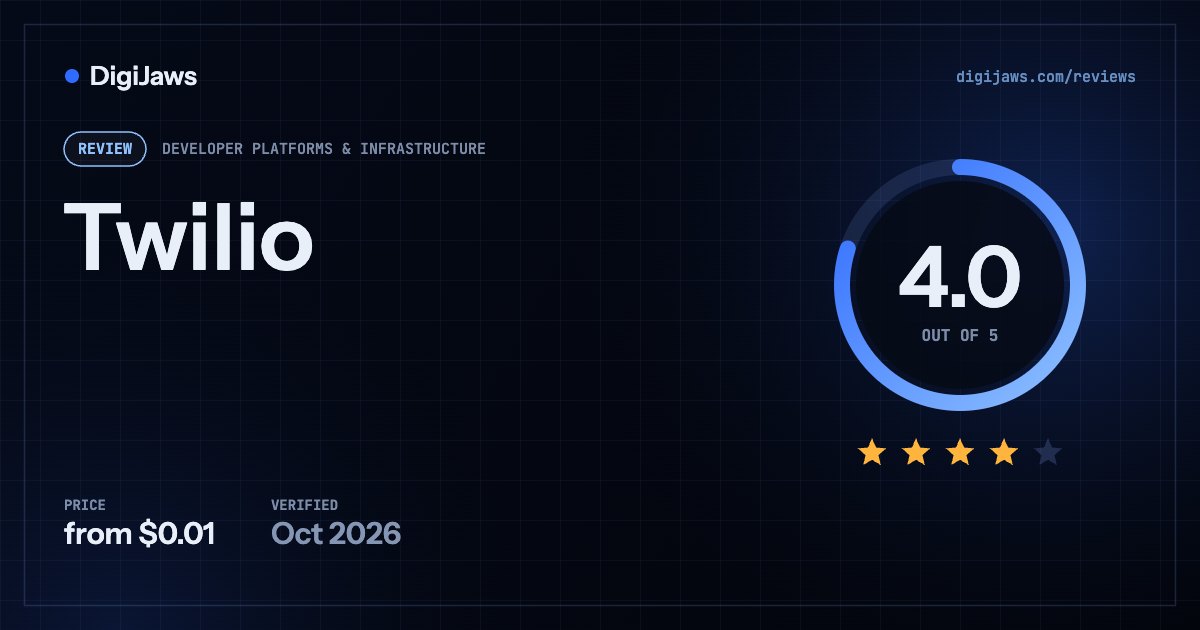
Twilio — Pure pay-as-you-go: $0.0083 per US text, $0.014 a minute for outbound calls and $1.15 a month for the number — plus carrier fees the page lists separately.
Short answer: Twilio has no subscription tiers. US SMS on a long code is $0.0083 per message segment sent or received, MMS is $0.022 outbound and $0.0165 inbound, and a local phone number rents for $1.15 a month ($2.15 for toll-free, $0.50 to bring your own). Voice is $0.0140 per minute for outbound local calls, $0.0085 inbound, $0.0220 inbound on toll-free and $0.0040 per minute for browser, app or SIP legs. Carrier fees and volume discounts are listed on the same pages, the AI conversation layer starts at $0.07 a minute for Conversation Relay, and a free trial with credit needs no card. The rates are marked current as of August 2026.
On this page
Verdict at a glance
Every unit price is public and per-use, with no platform fee, no seat minimum and a free trial that includes credit to buy a number and test — the model that made programmable messaging a commodity.
The headline $0.0083 is Twilio’s rate only. Carrier fees are added per message and per sender type, 10DLC registration is a separate process with its own charges, and MMS costs nearly three times an SMS — so budget from the fully loaded rate, not the per-segment figure.
Twilio remains the reference implementation for programmable communications, and its pricing pages are as transparent as usage-based pricing gets. There are no plans to choose: a US SMS segment is $0.0083 to send or receive on a long code or toll-free number, MMS is $0.022 outbound and $0.0165 inbound on long codes ($0.02 inbound on toll-free), and numbers rent at $1.15 a month for local, $2.15 for toll-free or $0.50 to bring your own. Voice follows the same pattern — $0.0140 per minute to make a local call, $0.0085 to receive one, $0.0220 to receive on toll-free, and $0.0040 per minute for browser, app and SIP legs, with a $0.10 charge per SIP refer. The newer conversational-AI products are priced the same way: Conversation Relay for voice agents at $0.07 a minute, Conversation Intelligence from $0.005 per thousand characters, Conversation Memory at $0.0028 per thousand characters plus $0.007 per recall, and Enterprise Knowledge at $0.018 per GB-hour. The free trial includes credit — the voice page cites $15 — to buy a number and test without a card. What keeps this at four rather than five is the arithmetic a buyer has to do. Twilio’s rate is one line; carrier fees are another, documented in their own section and varying by sender type; volume discounts kick in at published thresholds; and MMS at $0.022 is 2.7 times an SMS. Against pure-play SMS competitors — Telnyx at $0.004 a part plus carrier passthrough, Bandwidth at $0.004 per 10DLC message, Plivo at $0.0077 — Twilio is the dearest per segment, and buys its premium with breadth, documentation and the ecosystem around it. For a product that sends a few thousand messages a month that premium is a rounding error; at a million segments it is a procurement conversation, and Twilio’s own page invites it.
Quick facts
| Attribute | Detail |
|---|---|
| Ideal team | Product and engineering teams adding SMS, voice or email to an application |
| Learning curve | Low for the APIs; compliance (10DLC, toll-free verification) is the work |
| Setup time | Minutes to first message on the trial |
| Free trial | ⭐ Yes — includes credit, no card |
| Free tier | Trial only; no ongoing free allowance |
| Entry | $0.0083 per US SMS segment; $1.15/mo per local number |
| Voice | $0.0140/min outbound local; $0.0085/min inbound |
| Carrier fees | ⚠️ Additional, listed separately by sender type |
Overview
Twilio sells communications as APIs — SMS, MMS, WhatsApp and RCS messaging, voice calls, video, email through SendGrid, and a newer layer of conversational-AI services — and prices each on usage with no subscription. The US messaging page is explicit: on a 10-digit long code an SMS segment costs $0.0083 to send and $0.0083 to receive, an MMS $0.022 to send and $0.0165 to receive; toll-free numbers match the SMS rate and charge $0.022 and $0.02 for MMS; short codes are listed separately with their own monthly cost. Numbers rent monthly — $1.15 for a long code, $2.15 for toll-free, $0.50 to bring your own — and the page’s own sections cover volume discounts, carrier fees, features and number pricing, with rates marked current as of August 2026.
Voice is priced per minute by leg. Making a local call is $0.0140 per minute and receiving one $0.0085; toll-free calls are $0.0140 outbound and $0.0220 inbound; browser and app calls and SIP interface legs are $0.0040 per minute each way, and a refer from Twilio on SIP is $0.10. The page notes volume and committed-use discounts and that the free trial provides $15 to buy a phone number and test voice features. Email is sold as Twilio SendGrid on its own plan ladder — a free trial of 100 emails a day for 60 days, Essentials from $19.95 a month for 50,000 to 100,000 emails, Pro from $89.95 for 100,000 to 2.5 million with a dedicated IP, and Premier on quote.
The conversational-AI products sit on the same meter. Conversation Relay, which puts a voice agent on a call, starts at $0.07 per minute. Conversation Intelligence starts at $0.005 per thousand characters for Twilio-authored operators, or $0.002 per thousand input and $0.018 per thousand output characters for custom operators. Conversation Memory is $0.0028 per thousand characters for generation and $0.007 per memory recall; Enterprise Knowledge is $0.018 per GB-hour of storage and $0.005 per retrieval; the Conversation Orchestrator starts at $0.0002 per thousand characters ingested. Every one of these is a per-use rate with a ‘start for free’ path, which is consistent — and means a voice-agent deployment needs the same fully-loaded costing as an SMS campaign: minutes, plus the AI layer, plus the number, plus carrier charges where they apply.
Key features
- SMS and MMS$0.0083 per segment; MMS $0.022 out / $0.0165 in (long code)
- Phone numbers$1.15/mo local, $2.15 toll-free, $0.50 bring-your-own
- Voice$0.0140/min outbound local, $0.0085 inbound, $0.0040 browser/SIP
- Carrier fees and discounts⚠️ separate sections on the pricing page
- Conversation Relayvoice AI agents from $0.07 per minute
- Conversation Intelligencefrom $0.005 per 1k characters
- Conversation Memory$0.0028 per 1k characters, $0.007 per recall
- SendGrid emailEssentials from $19.95/mo, Pro from $89.95/mo
- Free trial⭐ credit included, no card
- Rates datedpages state ‘current as of August 2026’
Pricing (as of 2026-09-29)
Model: pure usage — per message segment, per minute, per number, per character for AI services · Free tier: Trial with credit only · Entry paid: $0.0083 per US SMS segment
| Plan | Price | Includes |
|---|---|---|
| SMS (US long code) | $0.0083 per segment | Same rate to send and receive · toll-free SMS also $0.0083 · ⚠️ carrier fees extra |
| MMS (US long code) | $0.022 out · $0.0165 in | Toll-free MMS $0.022 out · $0.02 in |
| Phone numbers | $1.15/mo local | $2.15/mo toll-free · $0.50/mo bring your own number |
| Voice (US) | $0.0140/min outbound local | $0.0085/min inbound local · $0.0220/min inbound toll-free · $0.0040/min browser, app and SIP |
| Conversational AI | From $0.07/min (Relay) | Intelligence from $0.005 per 1k chars · Memory $0.0028 per 1k chars · Knowledge $0.018 per GB-hour |
⚠️ Carrier fees are charged in addition to Twilio’s per-segment rate and are documented in their own section of the US pricing page by sender type. Compare against Telnyx and Bandwidth, which quote $0.004 per part plus carrier passthrough, and Plivo at $0.0077 — Twilio’s own rate is the highest of the four.
⚠️ MMS costs 2.7 times an SMS on outbound ($0.022 vs $0.0083). Campaigns that attach images should be costed on the MMS rate, not the SMS headline.
⭐ There is no platform fee, seat minimum or subscription. The free trial includes credit — the voice page cites $15 — to buy a number and test without a card, and volume and committed-use discounts are published thresholds rather than sales-only.
Email is priced separately under Twilio SendGrid: a 60-day free trial at 100 emails a day, Essentials from $19.95 a month, Pro from $89.95 with a dedicated IP, Premier on quote.
Ratings breakdown
Pros
- Every rate is public and per-use, with no subscription or seat minimum
- Free trial with credit and no card
- SMS priced the same to send and receive
- Volume and committed-use discounts published
- Conversational-AI layer priced on the same usage model
- SendGrid email on the same account
- Rates carry an ‘as of’ date on the page
Cons
- ⚠️ Carrier fees add to every message beyond Twilio’s rate
- ⚠️ $0.0083 per segment is above Telnyx, Bandwidth and Plivo
- ⚠️ MMS is 2.7x the SMS rate
- 10DLC and toll-free verification add process and cost before sending at scale
- No ongoing free allowance after the trial
- A voice-agent deployment stacks minutes, AI rates and number rental
Who it’s for
- Product teams that need reliable SMS, voice and email APIs with strong docs
- Businesses whose volume is small enough that the per-segment premium is immaterial
- Teams building voice agents who want Conversation Relay and telephony from one vendor
- Companies that value committed-use discounts and a mature compliance path
Who it’s not for
- High-volume SMS senders for whom Telnyx or Bandwidth at $0.004 a part is materially cheaper
- Anyone expecting a monthly plan with an included message bundle
- Teams that have not budgeted carrier fees and 10DLC registration
- Image-heavy campaigns priced on the SMS rate
Best use cases
- Sending transactional SMS at $0.0083 a segment from a $1.15 local number
- Two-factor authentication over SMS and voice
- Building a phone-based support agent on Conversation Relay at $0.07 a minute
- Sending 50,000 transactional emails a month on SendGrid Essentials at $19.95
- Recording and analysing calls with Conversation Intelligence
Integrations
Twilio is itself the integration layer — REST APIs and SDKs for every major language, with SIP trunking, WhatsApp and RCS alongside SMS and voice. Alerts from observability tools such as Datadog are commonly routed through Twilio for on-call paging, and application backends on Supabase or Vercel call it from edge and serverless functions. AI builders including Lovable and Bolt.new generate Twilio calls from a prompt.
How it compares
| Twilio | Telnyx | Bandwidth | Plivo | |
|---|---|---|---|---|
| US SMS outbound | $0.0083 per segment | $0.004 per part + carrier | $0.004 per message (10DLC) | $0.0077 per SMS |
| US SMS inbound | $0.0083 | $0.004 + carrier | Not listed on summary | $0.0077 |
| MMS outbound | ⚠️ $0.022 | $0.015 + carrier | $0.015 | $0.018 |
| Local number | $1.15/mo | Priced separately | Priced separately | $0.50/mo |
| Voice outbound | $0.0140/min | n/a on messaging page | $0.0100/min | n/a on SMS page |
| Free trial | ⭐ Credit included, no card | Sign up free | Contact | Sign up |
| Best fit | Breadth, docs and ecosystem | Lowest published rate with passthrough | Carrier-owned network at low rates | Cheaper Twilio-like API |
All figures read from each vendor’s own pricing page on 2026-09-29: twilio.com US SMS and voice pricing (marked current as of August 2026), telnyx.com/pricing/messaging, bandwidth.com/pricing and plivo.com/sms/pricing/us. Telnyx and Plivo both state that carrier fees or surcharges apply in addition; Twilio documents carrier fees in a separate section.
Alternatives
Telnyx publishes $0.004 per message part plus the carrier’s passthrough at cost, and its own example prices a million parts at $7,800 all-in — the cheapest published US rate of the four. Bandwidth, which owns its network, lists $0.004 per 10DLC message and $0.0100 per minute for outbound local voice. Plivo mirrors Twilio’s API at $0.0077 per SMS and $0.50 a month per long code. For email specifically, Twilio’s own SendGrid is the default and is priced on its own plan ladder. On the AI side, teams building agents with OpenAI‘s realtime models still need a telephony layer like Twilio to reach a phone.
Recent changes
As of 2026-09-29, Twilio’s US pricing pages (marked current as of August 2026) list SMS at $0.0083 per segment to send or receive on long codes and toll-free numbers, MMS at $0.022 outbound and $0.0165 inbound on long codes ($0.02 inbound on toll-free), and monthly number rental at $1.15 for local, $2.15 for toll-free and $0.50 for bring-your-own numbers. Voice is $0.0140 per minute for outbound local calls, $0.0085 inbound, $0.0220 inbound on toll-free and $0.0040 per minute for browser, app and SIP legs, with $0.10 per SIP refer. The conversational-AI products are priced per use: Conversation Relay from $0.07 a minute, Conversation Intelligence from $0.005 per thousand characters ($0.002 input and $0.018 output for custom operators), Conversation Memory at $0.0028 per thousand characters plus $0.007 per recall, Enterprise Knowledge at $0.018 per GB-hour and $0.005 per retrieval, and the Conversation Orchestrator from $0.0002 per thousand characters. Twilio SendGrid email is a free 60-day trial at 100 emails a day, Essentials from $19.95 a month, Pro from $89.95 and Premier on quote. The free trial includes credit and requires no card.
Frequently asked questions
How much does Twilio cost per text?
$0.0083 per SMS segment to send or receive in the US on a long code or toll-free number, plus carrier fees that Twilio lists separately by sender type. MMS is $0.022 to send and $0.0165 to receive on a long code. A local number rents for $1.15 a month.
Does Twilio have a monthly plan or free tier?
No plans and no ongoing free tier — everything is pay-as-you-go. The free trial includes credit (the voice page cites $15) to buy a number and test without a card, and volume and committed-use discounts are published on the pricing pages.
How much do Twilio voice calls cost?
$0.0140 per minute to make a local US call and $0.0085 per minute to receive one. Inbound toll-free is $0.0220 per minute, and browser, app and SIP legs are $0.0040 per minute each way, with a $0.10 charge per SIP refer.
Is Twilio cheaper than Telnyx, Bandwidth or Plivo?
No — on the published rate Twilio is the dearest: $0.0083 per segment against Telnyx and Bandwidth at $0.004 and Plivo at $0.0077, before carrier fees on all of them. Twilio’s premium buys documentation, breadth (voice, email, WhatsApp, AI) and the ecosystem; at small volumes the difference is negligible.
What does a Twilio voice agent cost?
Conversation Relay, which connects a voice AI to a call, starts at $0.07 per minute on top of the per-minute call rate ($0.0140 outbound or $0.0085 inbound) and the number rental. Conversation Intelligence and Memory add per-character charges if you use them, so a fully loaded agent minute is roughly $0.08 to $0.09 before the model provider’s own fees.
How is SendGrid email priced?
Separately from messaging: a free trial of 100 emails a day for 60 days, Essentials from $19.95 a month for 50,000 to 100,000 emails, Pro from $89.95 for 100,000 to 2.5 million with a dedicated IP included, and Premier on custom pricing.
Sources
- Twilio – US SMS/MMS pricing, carrier fees and number rental (read 2026-09-29)
- Twilio – US voice pricing (read 2026-09-29)
- Twilio – pricing overview including conversational AI services (read 2026-09-29)
- Twilio SendGrid – Email API pricing (read 2026-09-29)
Compiled from public sources; last verified 2026-09-29. Pricing is subject to change — verify with the vendor. Ratings reflect editorial opinion based on documented capabilities, published pricing, and aggregated user reviews. DigiJaws does not accept payment for review placement or rating.
Looking for the numbers? Our Twilio pricing page breaks down every plan, what each upgrade costs over a year, and what the headline price leaves out.
Twilio Review (4/5): Features & Verdict (2026). DigiJaws, 2026. https://digijaws.com/reviews/twilio-review/