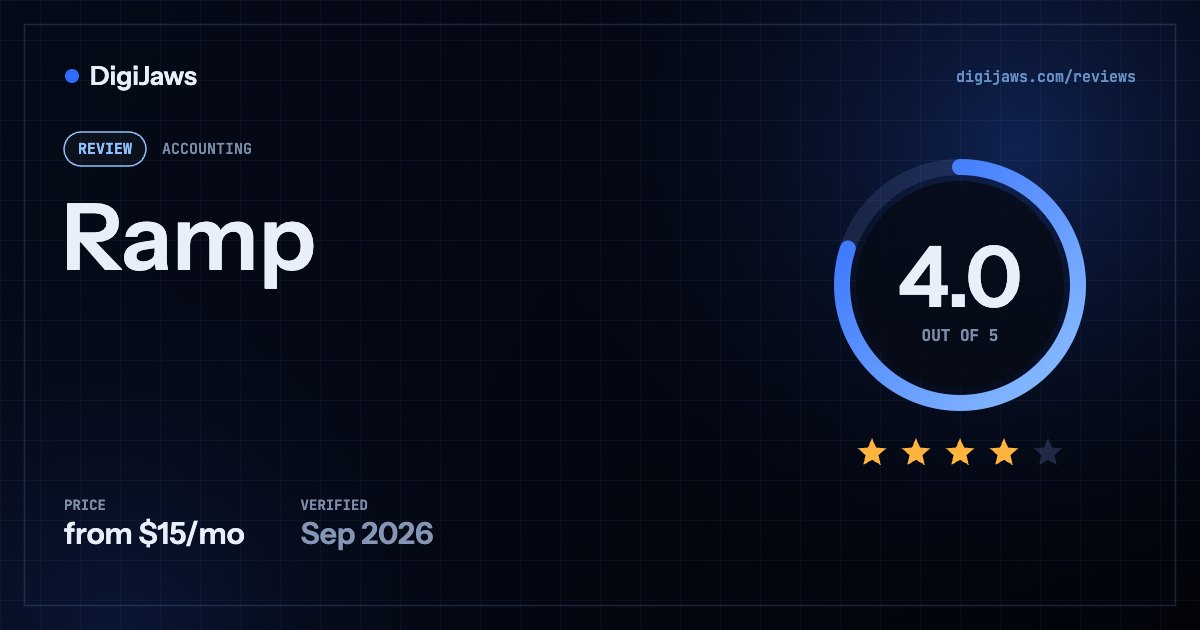
Ramp — Corporate cards, expense management, AP and accounting automation genuinely free — because the software is paid for by interchange on your card spend.
Short answer: Ramp provides corporate cards, expense management, accounts payable, accounting automation and reporting free of charge. The software tier is genuinely $0 per user a month, funded by interchange revenue on Ramp card spend. Ramp Plus is listed at $15 per user a month plus a platform fee that scales with team size, with 20% off annual billing. Enterprise pricing is custom.
On this page
Verdict at a glance
The free tier is a real product, not a trial. Cards, expenses, AP, accounting automation and reporting at $0 per user is not something the paid competitors match.
Free is funded by interchange on card spend. The real price is committing your company’s spend to the Ramp card programme — which is a strategic decision, not a software one.
Ramp gives away good software and is transparent about why. Corporate cards, expense management, accounts payable, accounting automation and reporting are all genuinely free at $0 per user a month, and this is a real product rather than a trial — companies run their entire spend operation on it without paying a subscription. The funding model is interchange revenue on Ramp card spend, which means the actual price of the free software is routing your company’s spending through Ramp’s card programme. That is worth stating plainly because it is a strategic commitment rather than a software purchase: you are choosing a payments provider, and switching later means re-issuing cards, re-establishing controls and migrating transaction history, not merely exporting data. Ramp Plus is listed at $15 per user a month plus a platform fee that scales with team size, with 20% off annual billing, and Enterprise is custom. Against Brex, which also offers a free Essentials tier with reportedly fewer features and Premium at $12 a user, Ramp’s free tier is the more generous — and Ramp remains independent, where Brex was acquired by Capital One in April 2026. If you are comfortable with the card commitment, this is excellent value.
Quick facts
| Attribute | Detail |
|---|---|
| Ideal team | Companies willing to route spend through one card programme |
| Learning curve | Low — the product is designed for finance teams, not accountants |
| Setup time | Days, including card issuance and controls |
| Free trial | ⭐ The core product is free permanently |
| Free tier | ⭐ Yes — cards, expenses, AP, accounting automation and reporting |
| Funding model | ⚠️ Interchange revenue on Ramp card spend |
| Plus | $15/user/month plus a platform fee, 20% off annual |
| Ownership | Independent |
Overview
Ramp bundles corporate cards with the software around them — expense management, accounts payable, accounting automation and reporting — and charges nothing for the software. This is not a limited free tier: companies run their entire spend operation on it. Cards are issued with controls, receipts are captured and matched, bills are paid, and the results are synced to the accounting system, all at $0 per user a month.
The funding model explains it and deserves to be stated rather than glossed. Ramp earns interchange revenue on card spend, so the software is subsidised by the payments volume it generates. That is a legitimate business model and it produces genuinely good software, but it changes what the buying decision actually is. You are not choosing a subscription you can cancel next quarter; you are choosing a payments provider, and switching later means re-issuing cards to every employee, re-establishing spend controls and migrating transaction history. Treat it as a strategic commitment.
Ramp Plus is listed at $15 per user a month plus a platform fee that scales with team size, with 20% off annual billing, and Enterprise pricing is custom. The platform fee is worth establishing precisely in any quote, since a per-user figure plus an unstated scaling fee is not a price you can model. Compared with Brex, which also offers a free Essentials tier reported to include fewer features and Premium at $12 a user, Ramp’s free tier is the more generous of the two — and Ramp remains independently owned, where Brex was acquired by Capital One with the deal completing on 7 April 2026.
Key features
- Corporate cardsissued with programmable spend controls
- Expense management⭐ free at $0 per user a month
- Accounts payablebill payment included in the free tier
- Accounting automationsync to your ledger without manual entry
- Reportingspend visibility included free
- Receipt capture and matchingautomated against card transactions
- Spend controlslimits and policies enforced at the card level
- Ramp Plus$15 per user a month plus a scaling platform fee
- 20% off annual billingon paid tiers
- Independent ownershipunlike Brex since April 2026
Pricing (as of 2026-09-22)
Model: free core software funded by card interchange; paid tiers per user plus platform fee · Free tier: ⭐ yes — cards, expenses, AP, accounting automation and reporting · Entry paid: $0 — core software is free
| Plan | Price | Includes |
|---|---|---|
| Free | $0 per user per month | ⭐ Corporate cards · expense management · accounts payable · accounting automation · reporting · ⚠️ funded by interchange revenue on Ramp card spend |
| Ramp Plus | $15/user/mo plus a platform fee | ⚠️ Platform fee scales with team size and is not published · 20% off annual billing |
| Enterprise | Custom | Negotiated terms for larger deployments |
⭐ The free tier is a genuine product, not a trial. Corporate cards, expense management, accounts payable, accounting automation and reporting at $0 per user a month is more than the paid tiers of several competitors provide.
⚠️ The software is free because Ramp earns interchange revenue on card spend. The real price is committing your company’s spending to the Ramp card programme — a strategic decision rather than a software purchase. Switching later means re-issuing cards, re-establishing controls and migrating transaction history, not simply exporting data.
⚠️ Ramp Plus is listed at $15 per user a month plus a platform fee that scales with team size, and that fee is not published. Establish it precisely in any quote — a per-user rate plus an unstated scaling fee is not a number you can budget from.
Ratings breakdown
Pros
- Corporate cards, expenses, AP and accounting automation genuinely free
- The free tier is a working product, not a limited trial
- Automated receipt capture and matching against card transactions
- Spend controls enforced at the card level rather than by policy alone
- More generous free tier than Brex Essentials
- 20% saving on annual billing for paid tiers
- Independently owned, unlike Brex since April 2026
- Accounting sync removes manual reconciliation work
Cons
- ⚠️ Free software is funded by interchange on your card spend
- ⚠️ Choosing Ramp is choosing a payments provider, not just software
- ⚠️ Ramp Plus adds an unpublished platform fee scaling with team size
- Switching later means re-issuing cards and migrating transaction history
- Not an accounting system — it syncs to one rather than replacing it
- Enterprise pricing is custom with no published reference point
- Value depends entirely on card spend volume being meaningful
Who it’s for
- Companies willing to route their spend through one card programme
- Finance teams wanting cards, expenses and AP from one free product
- Businesses whose card volume makes the interchange model work
- Organisations preferring an independent vendor over an acquired one
Who it’s not for
- Companies unwilling to commit spend to a single card provider
- Businesses with low card spend, where the model offers little
- Teams needing a full accounting ledger — use Zoho Books or Sage
- Anyone who needs the Plus platform fee published before deciding
Best use cases
- Running an entire spend operation at $0 per user a month
- Issuing employee cards with limits enforced at the card level
- Automating receipt capture and matching against transactions
- Paying bills through accounts payable without a separate tool
- Syncing spend data into an accounting system automatically
Integrations
Ramp syncs to the major accounting systems, which is the integration that determines whether the free automation actually saves work — spend data that lands correctly coded in your ledger removes reconciliation, while spend data that needs re-keying does not. Verify the depth of the integration with your specific accounting platform before committing, since that connection is where the product’s practical value is realised.
How it compares
| Ramp | Brex | Expensify | Zoho Books | |
|---|---|---|---|---|
| Entry paid | ⭐ $0 — core software free | $0 (Essentials) | $5/member/mo (Collect) | $15/mo annual (Standard) |
| Funding model | ⚠️ Card interchange | ⚠️ Card interchange | ⚠️ Card discount halves price | Subscription |
| Free tier scope | ⭐ Cards, expenses, AP, accounting | Fewer features reported | Limited | Under $50K revenue |
| Paid tier | $15/user + platform fee | $12/user (Premium) | $9-$36/member (Control) | $15-$240/mo by tier |
| Ownership | ⭐ Independent | ⚠️ Capital One since April 2026 | Independent | Zoho |
| Full accounting ledger | No — syncs to one | No | No | ⭐ Yes |
| Best fit | Spend management on card volume | Corporate cards | Expense management | Small business accounting |
Zoho Books prices are vendor-published and verified 2026-09-22. Ramp, Brex, Expensify and Sage figures are from published third-party reporting where the vendors’ own pages could not be retrieved directly.
Alternatives
Brex is the direct competitor with a similar interchange-funded model and a free Essentials tier, though it is now owned by Capital One. Expensify applies the same logic differently, halving its Control plan price when you use its card. For an actual accounting ledger rather than spend management, Zoho Books and Sage Accounting are the tools.
Recent changes
Ramp continues to provide corporate cards, expense management, accounts payable, accounting automation and reporting free of charge, with the software tier genuinely priced at $0 per user a month and funded by interchange revenue on Ramp card spend. Ramp Plus is listed at $15 per user a month plus a platform fee that scales with team size, with 20% off annual billing, and Enterprise pricing remains custom. Ramp remains independently owned, in contrast to Brex, whose acquisition by Capital One was announced on 22 January 2026 and completed on 7 April 2026. Independent comparisons continue to describe Ramp’s free tier as more feature-complete than Brex’s free Essentials tier, while noting that in both cases the economics depend on card spend volume rather than on software subscription revenue.
Frequently asked questions
Is Ramp really free?
Yes — corporate cards, expense management, accounts payable, accounting automation and reporting are genuinely $0 per user a month, and it is a working product rather than a trial. The software is funded by interchange revenue on Ramp card spend, so the real price is routing your company’s spending through Ramp’s card programme.
What is the catch with Ramp’s free software?
Not a catch so much as a different kind of commitment. Because the model depends on interchange, choosing Ramp means choosing a payments provider — and switching later requires re-issuing cards to every employee, re-establishing spend controls and migrating transaction history, rather than simply exporting data. Treat it as strategic rather than as a software subscription.
How much does Ramp Plus cost?
It is listed at $15 per user a month plus a platform fee that scales with team size, with 20% off annual billing. The platform fee is not published, which means the headline per-user rate is not a number you can budget from — establish the fee precisely in any quote before comparing against competitors’ per-user pricing.
Ramp or Brex?
Ramp’s free tier is reported to be more feature-complete than Brex‘s free Essentials, and Ramp remains independently owned where Brex was acquired by Capital One, completing on 7 April 2026. Brex Premium is listed slightly lower at $12 a user against Ramp Plus’s $15 plus platform fee. Both depend on the same interchange economics.
Does Ramp replace my accounting software?
No. Ramp handles spend — cards, expenses, bill payment — and syncs the results into an accounting system. You still need a ledger, which is where Zoho Books or Sage Accounting come in. Verify the integration depth with your specific platform, since that connection determines whether the automation saves real work.
When does Ramp’s model not work?
When your card spend is low. The software is free because interchange on card volume pays for it, so a business with modest card spending is not generating the revenue that funds the product — and may find the commitment to a single card provider outweighs the value of free software. Model your actual card volume before deciding.
What is the difference between Ramp Free and Plus?
The free tier already includes cards, expense management, accounts payable, accounting automation and reporting, which covers most companies’ needs. Plus at $15 a user plus a platform fee adds further capability. Given how complete the free tier is, the honest advice is to start free and upgrade only when a specific missing capability forces it.
Sources
- Layer3Labs — Ramp vs Brex 2026: cards, AI spend and pricing compared
- Kleercard — Ramp vs Brex 2026: honest comparison after the Capital One acquisition
- Zoho Books — official pricing page
- Costbench — Expensify pricing 2026: free to $250 per user per month
- Sage — Sage Accounting pricing (vendor, UK)
Compiled from public sources; last verified 2026-09-22. Pricing is subject to change — verify with the vendor. Ratings reflect editorial opinion based on documented capabilities, published pricing, and aggregated user reviews. DigiJaws does not accept payment for review placement or rating.
Looking for the numbers? Our Ramp pricing page breaks down every plan, what each upgrade costs over a year, and what the headline price leaves out.
Ramp Review (4/5): Features & Verdict (2026). DigiJaws, 2026. https://digijaws.com/reviews/ramp-review/