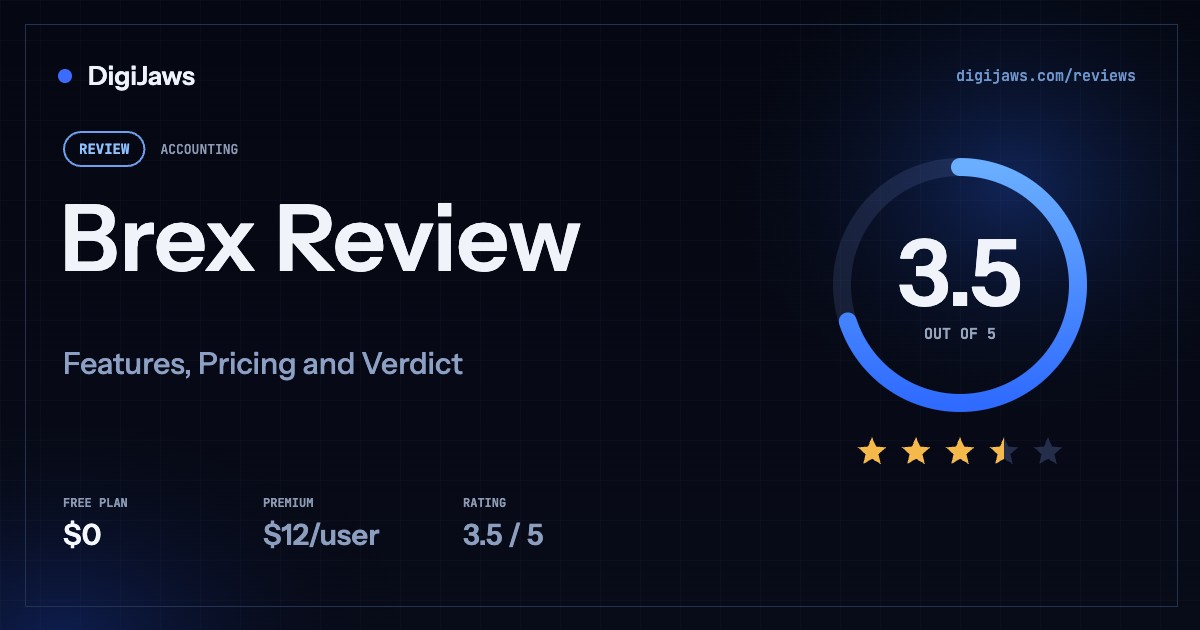
Brex — Corporate cards with a free Essentials tier — and a new owner, after Capital One completed its acquisition in April 2026.
Short answer: Brex provides corporate cards and spend management with a free Essentials tier, reported to include fewer features than Ramp’s free plan. Premium is listed at $12 per user a month, with custom enterprise pricing above that. Capital One announced its acquisition of Brex on 22 January 2026 and completed it on 7 April 2026, stating that products, pricing and support are unchanged for now.
On this page
Verdict at a glance
A free tier from a card provider with genuine scale, and Premium at $12 a user undercuts Ramp Plus’s $15 plus platform fee.
Capital One completed its acquisition on 7 April 2026 and says pricing is unchanged “for now” — which is precisely the phrase to plan around rather than rely on.
Brex is a capable corporate card and spend management platform whose most important development in 2026 has nothing to do with its features. Capital One announced its acquisition on 22 January 2026 and completed it on 7 April, with the message that products, pricing and support are unchanged for now. That last phrase is doing a lot of work. Acquisitions by large financial institutions have a consistent pattern, and this review’s own hub contains several examples of what follows — Salesforce acqui-hiring the Clockwise team, after which Clockwise shut down about a week later, Contentsquare redirecting Hotjar’s pricing page to its own. None of that has happened to Brex, and Capital One brings resources a standalone fintech does not have. But “unchanged for now” is a reason to prefer shorter commitments and keep your data exportable, not a reassurance. On the product itself, Brex offers a free Essentials tier reported to include fewer features than Ramp‘s free plan, with Premium listed at $12 per user a month — undercutting Ramp Plus at $15 plus an unpublished platform fee — and custom enterprise pricing above. Both run on the same interchange economics, so the real commitment in either case is your card volume.
Quick facts
| Attribute | Detail |
|---|---|
| Ideal team | Companies wanting corporate cards from a provider with scale behind it |
| Learning curve | Low — designed for finance teams |
| Setup time | Days, including card issuance and controls |
| Free trial | Free Essentials tier |
| Free tier | Yes — Essentials, reported narrower than Ramp’s |
| Premium | $12 per user per month |
| Ownership | ⚠️ Capital One — acquisition completed 7 April 2026 |
| Key limit | ⚠️ Pricing described as unchanged “for now” |
Overview
Brex provides corporate cards alongside expense management and spend controls, competing directly with Ramp for the same buyers and on broadly the same economics — software subsidised by interchange revenue on card spend. It offers a free Essentials tier, reported by independent comparisons to include fewer features than Ramp’s free plan, with Premium listed at $12 per user a month and custom enterprise pricing above that. On per-user rate alone Premium undercuts Ramp Plus at $15 plus an unpublished platform fee.
The ownership change is the defining fact of 2026 for Brex buyers. Capital One announced the acquisition on 22 January 2026 and completed it on 7 April 2026, saying that products, pricing and support are unchanged for now. Capital One brings balance-sheet strength and regulatory infrastructure that a standalone fintech does not have, which for a company entrusting its payments to a provider is a genuine argument in favour. It also brings the roadmap dependency that every acquisition brings.
How much weight to give that depends on your appetite for uncertainty, and this review’s own hub offers relevant precedent in both directions. Salesforce acqui-hired the Clockwise team rather than buying the company, and Clockwise shut the product down about a week later, on 27 March 2026, deleting customer data. Contentsquare acquired Hotjar and redirected its pricing page entirely, and acquired Heap, whose users report reduced support since. Against that, plenty of acquisitions leave products running well for years. Nothing adverse has happened to Brex. But “unchanged for now” is a description of the present rather than a commitment about the future, and the sensible response is to prefer shorter commitments, keep transaction data exportable, and revisit the decision at renewal rather than assuming continuity.
Key features
- Corporate cardsissued with spend controls
- Free Essentials tierreported narrower than Ramp’s free plan
- Expense managementreceipt capture and coding
- Accounts payablebill payment within the platform
- Spend controlspolicies enforced at the card level
- Premium at $12 per userundercuts Ramp Plus on per-user rate
- Accounting integrationssync spend into the ledger
- Enterprise tiercustom pricing
- Capital One backingbalance-sheet strength since April 2026
- Mobile appsiOS and Android
Pricing (as of 2026-09-22)
Model: free tier plus per-user paid plans, funded partly by card interchange · Free tier: yes — Essentials, reported to include fewer features than Ramp’s · Entry paid: $12/user/mo (Premium)
| Plan | Price | Includes |
|---|---|---|
| Essentials | $0 | Free tier · corporate cards and core spend management · reported to include fewer features than Ramp’s free plan |
| Premium | $12 per user per month | ⭐ Undercuts Ramp Plus at $15 per user plus an unpublished platform fee |
| Enterprise | Custom | Negotiated terms for larger deployments |
⚠️ Capital One announced its acquisition of Brex on 22 January 2026 and completed it on 7 April 2026, stating that products, pricing and support are unchanged for now. That phrase describes the present rather than committing to the future — prefer shorter commitments, keep transaction data exportable, and revisit at renewal.
⭐ Premium at $12 per user a month undercuts Ramp Plus, listed at $15 per user plus a platform fee that scales with team size and is not published. On per-user rate alone, Brex is the cheaper paid tier.
⚠️ Brex’s free Essentials tier is reported by independent comparisons to include fewer features than Ramp’s free plan. Both models are funded by interchange on card spend, so in either case the real commitment is routing your company’s spending through one provider.
Ratings breakdown
Pros
- Free Essentials tier for corporate cards and core spend management
- Premium at $12 per user undercuts Ramp Plus at $15 plus platform fee
- Capital One backing brings balance-sheet strength and regulatory infrastructure
- Spend controls enforced at the card level
- Accounts payable and expense management included
- Accounting integrations sync spend into the ledger
- Custom enterprise pricing available
- Mobile apps on iOS and Android
Cons
- ⚠️ Capital One acquisition completed 7 April 2026; pricing unchanged “for now”
- ⚠️ Free Essentials tier reported to be narrower than Ramp’s free plan
- Interchange-funded model means committing card volume to one provider
- Enterprise pricing is custom with no published reference point
- Not an accounting ledger — it syncs to one rather than replacing it
- Roadmap now follows a large financial institution’s priorities
- Switching later means re-issuing cards and migrating transaction history
Who it’s for
- Companies wanting corporate cards from a provider with institutional scale
- Teams for whom Premium at $12 a user beats Ramp Plus on price
- Businesses comfortable with Capital One ownership and its implications
- Organisations whose card volume makes the interchange model work
Who it’s not for
- Companies wanting the most feature-complete free tier — that is Ramp
- Teams uneasy about post-acquisition roadmap and pricing uncertainty
- Businesses needing a full accounting ledger — use Zoho Books or Sage
- Organisations unwilling to commit spend to a single card provider
Best use cases
- Issuing corporate cards with controls on the free Essentials tier
- Running spend management at $12 a user on Premium
- Paying bills through accounts payable within the platform
- Syncing coded spend into an accounting system automatically
- Comparing Premium’s $12 against Ramp Plus’s $15 plus platform fee
Integrations
Brex syncs to the major accounting systems, which is the integration determining whether spend automation saves real work — correctly coded transactions arriving in the ledger remove reconciliation, while transactions needing re-keying do not. Under Capital One ownership the integration roadmap now sits with a large financial institution, so verify current support for your specific accounting platform rather than relying on pre-acquisition documentation.
How it compares
| Brex | Ramp | Expensify | Zoho Books | |
|---|---|---|---|---|
| Entry paid | $0 (Essentials) | ⭐ $0 — free software | $5/member/mo (Collect) | $15/mo annual |
| Paid tier | ⭐ $12/user/mo | $15/user + platform fee | $9-$36/member (Control) | $15-$240/mo by tier |
| Free tier scope | Fewer features reported | ⭐ Cards, expenses, AP, accounting | Limited | Under $50K revenue |
| Funding model | ⚠️ Card interchange | ⚠️ Card interchange | ⚠️ Card discount | Subscription |
| Ownership | ⚠️ Capital One since April 2026 | ⭐ Independent | Independent | Zoho |
| Full accounting ledger | No | No — syncs to one | No | ⭐ Yes |
| Best fit | Corporate cards at scale | Spend management | Expense management | Small business accounting |
Zoho Books prices are vendor-published and verified 2026-09-22. Ramp, Brex, Expensify and Sage figures are from published third-party reporting where the vendors’ own pages could not be retrieved directly.
Alternatives
Ramp is the direct competitor with a more feature-complete free tier and independent ownership, though its Plus tier costs more once the platform fee is counted. Expensify offers expense management alongside existing banking arrangements rather than replacing them. For an accounting ledger rather than spend management, Zoho Books and Sage Accounting are the relevant tools.
Recent changes
The defining change for Brex in 2026 is ownership. Capital One announced its acquisition of Brex on 22 January 2026 and completed the transaction on 7 April 2026, stating that products, pricing and support are unchanged for now. Brex continues to offer a free Essentials tier covering corporate cards and core spend management, which independent comparisons report as including fewer features than Ramp’s free plan, alongside Premium listed at $12 per user a month and custom enterprise pricing. Both Brex and Ramp continue to operate on interchange-funded economics, where software costs are subsidised by revenue earned on card spend rather than recovered primarily through subscription fees. On per-user rate, Brex Premium at $12 sits below Ramp Plus, which is listed at $15 per user a month plus a platform fee that scales with team size and is not published.
Frequently asked questions
How much does Brex cost?
Essentials is free, covering corporate cards and core spend management, though independent comparisons report it includes fewer features than Ramp’s free plan. Premium is listed at $12 per user a month, and enterprise pricing is custom. On per-user rate Premium undercuts Ramp Plus, listed at $15 plus an unpublished platform fee.
Who owns Brex now?
Capital One. The acquisition was announced on 22 January 2026 and completed on 7 April 2026, with Capital One stating that products, pricing and support are unchanged for now. That phrase describes the present rather than committing to the future, so treat it as a reason for shorter commitments rather than as a guarantee.
Should the Capital One acquisition change my decision?
It should change how you commit rather than whether you evaluate. Capital One brings balance-sheet strength and regulatory infrastructure a standalone fintech lacks, which is genuinely reassuring for a payments provider. But prefer shorter terms, keep transaction data exportable and revisit at renewal — sensible practice with any vendor whose ownership has just changed.
Brex or Ramp?
Ramp has the more feature-complete free tier — cards, expenses, accounts payable and accounting automation — and remains independently owned. Brex Premium at $12 a user undercuts Ramp Plus at $15 plus platform fee. Both run on interchange economics, so in either case the real commitment is your card volume, not the subscription.
Is Brex’s free tier good enough?
For core corporate card use with spend controls, generally yes — but independent comparisons consistently report it as narrower than Ramp’s, which includes accounts payable and accounting automation free. If the free tier is the reason you are evaluating, compare feature lists directly rather than assuming the two are equivalent.
Does Brex replace accounting software?
No. It handles cards and spend and syncs results into an accounting system. You still need a ledger — Zoho Books is free under $50,000 revenue and Sage Accounting charges flat per account. Verify the integration with your specific platform under current ownership.
What is the real cost of Brex’s free tier?
Committing your company’s card spend to Brex, since the model is funded by interchange revenue rather than subscriptions. That is a strategic decision rather than a software one: switching later means re-issuing cards to every employee, re-establishing controls and migrating transaction history. The same is true of Ramp.
Sources
- Kleercard — Ramp vs Brex 2026: honest comparison after the Capital One acquisition
- Layer3Labs — Ramp vs Brex 2026: cards, AI spend and pricing compared
- Relay — Brex vs Ramp 2026: which corporate card fits your business?
- Zoho Books — official pricing page
- Costbench — Expensify pricing 2026: free to $250 per user per month
Compiled from public sources; last verified 2026-09-22. Pricing is subject to change — verify with the vendor. Ratings reflect editorial opinion based on documented capabilities, published pricing, and aggregated user reviews. DigiJaws does not accept payment for review placement or rating.
Looking for the numbers? Our Brex pricing page breaks down every plan, what each upgrade costs over a year, and what the headline price leaves out.
Brex Review (3.5/5): Features & Verdict (2026). DigiJaws, 2026. https://digijaws.com/reviews/brex-review/