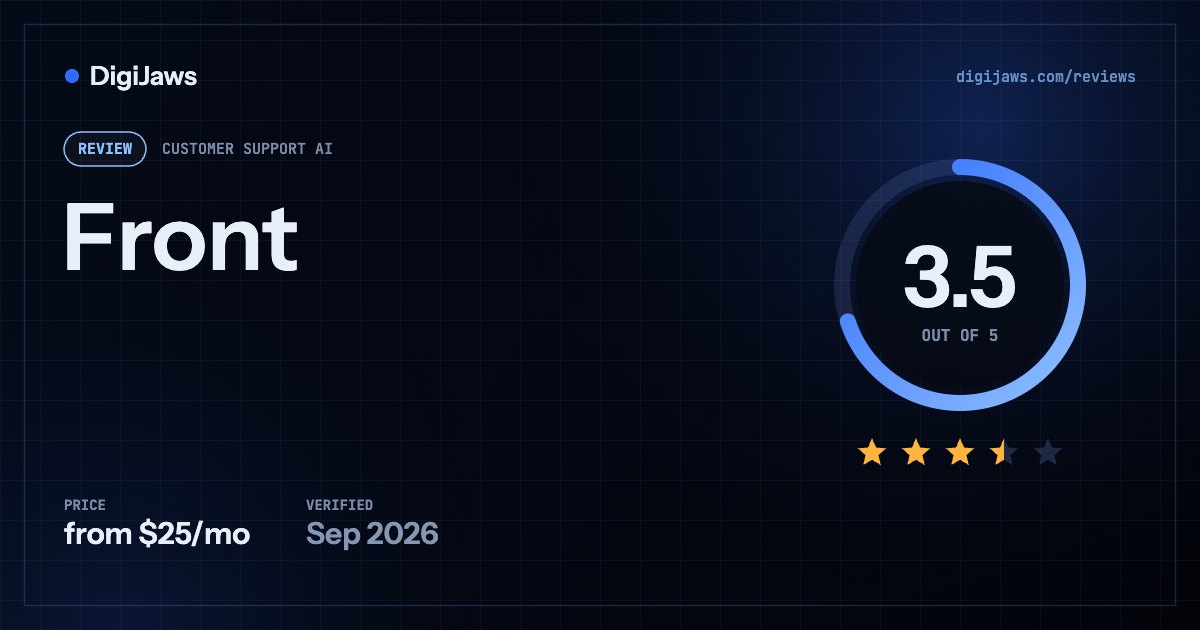
Front — The best shared inbox for teams who reply as humans — repriced in 2026 to three tiers, with the entry plan locked to a single channel type.
Short answer: Front consolidated its pricing in 2026 from four tiers to three. On annual billing it is $25 per seat a month for Starter, $65 for Professional and $105 for Enterprise. Starter is limited to a single channel type — email, chat or SMS — and a maximum of 10 seats. Professional supports up to 50 seats. Enterprise includes most AI features by default, excluding Autopilot. Monthly billing runs roughly 24% higher.
On this page
Verdict at a glance
Collaboration on shared inboxes. Internal comments, assignment and drafts alongside customer email is a genuinely better model than ticketing for teams whose replies are written by people.
Starter at $25 covers one channel type only — email or chat or SMS, not a combination — and caps at 10 seats. Multi-channel starts at $65 a seat.
Front’s model is different from a help desk and better for a specific kind of team. Rather than converting messages into tickets, it keeps them as conversations in a shared inbox and layers collaboration on top: internal comments beside the customer thread, assignment, shared drafts, and visibility into who is handling what. For teams whose replies are written by people rather than resolved by process — account management, client services, operations — that is a genuinely better model than ticketing, and Front executes it better than anyone. The 2026 repricing consolidated four tiers into three: $25 a seat for Starter, $65 for Professional and $105 for Enterprise on annual billing, with monthly running roughly 24% higher. Note that the old Starter, Growth, Scale and Premier structure at $19, $59, $99 and $229 is no longer in use, so much of the pricing discussion still circulating describes plans you cannot buy. Two limits shape the decision. Starter at $25 supports a single channel type only — email or chat or SMS, not a combination — and caps at 10 seats, so any team supporting customers across more than one channel starts at $65. And most AI features arrive by default only at Enterprise at $105, with Autopilot excluded even there. Excellent product, tier boundaries drawn tightly.
Quick facts
| Attribute | Detail |
|---|---|
| Ideal team | Teams whose customer replies are written by people, not resolved by process |
| Learning curve | Low — it behaves like an email client with collaboration |
| Setup time | Under a day |
| Free trial | Trial available; no permanent free tier |
| Free tier | No |
| Tiers | ⚠️ Repriced in 2026 — four tiers consolidated to three |
| Starter limits | ⚠️ One channel type only, maximum 10 seats |
| Annual saving | Up to 24% against monthly billing |
Overview
Front treats customer communication as conversation rather than as tickets. Messages arrive in a shared inbox that looks and behaves like email, and the collaboration layer sits alongside them: internal comments on a thread that the customer never sees, assignment so it is clear who owns a reply, shared drafts so a colleague can review before sending, and enough visibility that two people do not answer the same message. For account management, client services and operations teams — where the reply is a considered human response rather than the resolution of a defined process — this is a better fit than a help desk, and it is why Front retains customers who could pay less elsewhere.
Front consolidated its pricing in 2026, moving from four tiers to three. On annual billing, Starter is $25 per seat a month, Professional $65 and Enterprise $105. Front advertises savings of up to 24% for annual payment, so monthly billing runs roughly a quarter higher. It is worth flagging that the previous structure — Starter at $19, Growth at $59, Scale at $99 and Premier at $229 — is no longer in use, which means a substantial amount of the pricing commentary still in circulation describes plans that cannot be bought.
The tier boundaries matter more than the rates. Starter at $25 is limited to a single channel type — email or chat or SMS, not a combination — and to a maximum of 10 seats. Any team supporting customers across more than one channel therefore starts at Professional at $65 a seat, which also raises the seat ceiling to 50. Enterprise at $105 adds most AI features by default, with Autopilot excluded, alongside advanced permissions and reporting. So the AI capability that competitors sell as add-ons is here bundled into the top tier instead, which is more honest but not cheaper: an AI-equipped Front seat is $105 against Freshdesk’s $84 for Pro plus Copilot.
Key features
- Shared inboxconversations rather than tickets, with team visibility
- Internal commentsdiscuss a thread without the customer seeing it
- Assignment and ownershipclear accountability for each reply
- Shared draftscolleagues review before a message sends
- Multi-channel⚠️ requires Professional at $65; Starter is one channel type
- Rules and automationrouting and triage without ticket states
- Analytics and reportingadvanced reporting at Enterprise
- Most AI features⚠️ included by default at Enterprise, Autopilot excluded
- Advanced permissionsEnterprise tier
- Apps across web, mobile and desktop
Pricing (as of 2026-09-19)
Model: per-seat tiers on annual billing; repriced in 2026 from four tiers to three · Free tier: no — trial only · Entry paid: $25/seat/mo on annual billing (Starter)
| Plan | Price | Includes |
|---|---|---|
| Starter | $25/seat/mo annual | ⚠️ A single channel type only — email or chat or SMS, not a combination · ⚠️ maximum 10 seats · core shared inbox and collaboration |
| Professional | $65/seat/mo annual | Multi-channel support · up to 50 seats · rules, automation and analytics |
| Enterprise | $105/seat/mo annual | ⭐ Most AI features included by default, excluding Autopilot · advanced permissions · advanced reporting |
| Retired structure | ⚠️ No longer available | The former Starter $19, Growth $59, Scale $99 and Premier $229 tiers are no longer in use — much circulating pricing commentary describes plans you cannot buy |
⚠️ Front repriced in 2026, consolidating four tiers into three. The former Starter at $19, Growth at $59, Scale at $99 and Premier at $229 no longer exist, so a substantial amount of pricing commentary still in circulation describes plans that cannot be purchased. Verify against Front’s own page rather than a comparison article.
⚠️ Starter at $25 supports a single channel type only — email or chat or SMS, not a combination — and caps at 10 seats. Any team handling customers across more than one channel starts at Professional at $65 a seat, which is the realistic entry price for most support functions.
Most AI features are included by default at Enterprise at $105 a seat, with Autopilot excluded. Bundling AI into a tier rather than selling it as a per-agent add-on is more honest than the alternative, but not cheaper: an AI-equipped Front seat is $105 against Freshdesk‘s $84 for Pro plus Copilot. Annual billing saves up to 24%.
Ratings breakdown
Pros
- The best shared inbox collaboration model in this comparison
- Internal comments and shared drafts alongside customer threads
- Clear assignment prevents duplicate replies
- Behaves like an email client, so teams adopt it quickly
- Most AI features bundled into Enterprise rather than sold per agent
- Professional supports multi-channel with up to 50 seats
- Annual billing saves up to 24%
- Apps across web, mobile and desktop
Cons
- ⚠️ Starter limited to a single channel type and 10 seats
- ⚠️ Multi-channel requires Professional at $65 a seat
- ⚠️ Most AI features require Enterprise at $105 a seat
- Autopilot excluded even at the Enterprise tier
- No free tier, only a trial
- 2026 repricing means much published comparison data is stale
- Formal ticketing depth trails Freshdesk
Who it’s for
- Teams whose customer replies are written by people, not resolved by process
- Account management, client services and operations functions
- Organisations wanting collaboration visible alongside customer threads
- Teams who want AI bundled into a tier rather than billed per agent
Who it’s not for
- Teams needing formal ticketing with SLAs — use Freshdesk
- Small teams supporting more than one channel on a budget
- Cost-focused buyers — Crisp covers four agents for $45 a workspace
- Anyone relying on published comparisons written before the 2026 repricing
Best use cases
- Running a client services inbox where several people share ownership
- Discussing a customer thread internally before anyone replies
- Reviewing a colleague’s draft before it reaches the customer
- Supporting email, chat and SMS together on the Professional tier
- Using bundled AI features at the Enterprise tier without per-agent fees
Integrations
Front integrates broadly across CRM, ecommerce, project and communication tools, and its API supports custom work. The integrations that matter most are CRM-side: because Front’s model is conversation rather than ticket, seeing the customer record beside the thread is what turns a shared inbox into an account management tool. For teams choosing Front over a help desk, that context is usually the reason.
How it compares
| Front | Freshdesk | Crisp | Tidio | |
|---|---|---|---|---|
| Entry paid | $25/seat/mo annual | $19/agent/mo annual | $45/mo per workspace | $29/mo (Starter) |
| Realistic entry | ⚠️ $65 for multi-channel | ⚠️ $84 with AI Copilot | $45 Mini | ⚠️ ~$150-$250 with AI |
| Entry tier channels | ⚠️ One type only | Email and ticketing | Chat and inbox | Chat |
| Seat caps | ⚠️ 10 Starter, 50 Professional | None published | 4-20 bundled by tier | 10 on Free |
| AI model | ⭐ Bundled at Enterprise | ⚠️ $29/agent add-on | Chatbot included | ⚠️ Billed separately |
| Free tier | No | ⚠️ 2 agents, 6 months | Yes — 2 seats | Yes — 50 conversations |
| Best fit | Shared inbox collaboration | Ticketing at low entry | Per-workspace live chat | SMB chat |
Chatbase prices are vendor-published and verified 2026-09-19. Crisp, Front, Freshdesk and Tidio figures are from published third-party reporting where the vendors’ own pages could not be retrieved directly.
Alternatives
Freshdesk is the choice when you need formal ticketing with queues and SLAs rather than collaborative inboxes, at $19 an agent before AI. Crisp is far cheaper for small teams at $45 per workspace covering four agents. Tidio targets SMB live chat. Chatbase is the option when AI deflection rather than human collaboration is the goal.
Recent changes
Front consolidated its pricing in 2026, moving from four tiers down to three. On annual billing the current structure is Starter at $25 per seat a month, Professional at $65 and Enterprise at $105, with Front advertising savings of up to 24% for annual payment, meaning monthly billing runs roughly a quarter higher. Starter is limited to a single channel type — email or chat or SMS — and a maximum of 10 seats. Professional supports up to 50 seats. Enterprise includes most AI features by default, with Autopilot excluded, alongside advanced permissions and reporting. The previous four-tier structure of Starter at $19, Growth at $59, Scale at $99 and Premier at $229 per seat a month is no longer in use, so pricing commentary published before the consolidation describes plans that are no longer available for purchase.
Frequently asked questions
How much does Front cost?
On annual billing, Starter is $25 per seat a month, Professional $65 and Enterprise $105, with monthly billing roughly 24% higher. Starter is limited to a single channel type and 10 seats, so most support teams start at Professional. Enterprise includes most AI features by default, excluding Autopilot.
Did Front change its pricing in 2026?
Yes — it consolidated four tiers into three. The former Starter at $19, Growth at $59, Scale at $99 and Premier at $229 are no longer available, replaced by Starter at $25, Professional at $65 and Enterprise at $105. A great deal of published comparison data still describes the old structure, so verify against Front’s own page.
What is the catch with Front’s Starter plan?
Two things. It supports a single channel type only — email or chat or SMS, not a combination — and it caps at 10 seats. Any team handling customers across more than one channel therefore needs Professional at $65 a seat, which is 2.6 times the headline. Treat $65 as the realistic entry price for a support function.
Does Front include AI features?
Most of them are included by default at Enterprise at $105 a seat, with Autopilot excluded even there. Bundling AI into a tier is more honest than selling it per agent, but it is not cheaper — an AI-equipped Front seat is $105 against Freshdesk‘s $84 for Pro plus Freddy Copilot.
Front or Freshdesk?
Front when replies are written by people and collaboration matters — internal comments, shared drafts and clear ownership on a conversation. Freshdesk when work arrives as tickets needing queues, SLAs and routing. They are genuinely different models, and choosing on price alone tends to produce the wrong answer for both.
Does Front have a free plan?
How many seats does each Front tier allow?
Starter caps at 10 seats and Professional at 50, with Enterprise unstated. Those ceilings matter alongside the channel restriction: a growing team can hit Starter’s seat limit and its single-channel limit independently, and either one forces the move to $65 a seat. Model both before committing to the entry tier.
Sources
- Hiver — Front pricing 2026: plans, real costs and what teams actually pay
- Drag — Front pricing in 2026: every tier, add-on and seat cliff, costed
- Get Macha — Front pricing explained 2026: plans and real costs
- Costbench — Freshdesk pricing 2026: 4 plans from free to $89/agent/month
- Chatbase — official pricing page
Compiled from public sources; last verified 2026-09-19. Pricing is subject to change — verify with the vendor. Ratings reflect editorial opinion based on documented capabilities, published pricing, and aggregated user reviews. DigiJaws does not accept payment for review placement or rating.
Looking for the numbers? Our Front pricing page breaks down every plan, what each upgrade costs over a year, and what the headline price leaves out.
Front Review (3.5/5): Features & Verdict (2026). DigiJaws, 2026. https://digijaws.com/reviews/front-review/