Best Guides Tools, Reviewed
Marketing guides, explainers, benchmarks and pricing analysis — editorial pieces rather than individual tool reviews.
37 articles
-
Pricing
What “starts at” hides
“Starts at $19” is a true statement about a plan. It is rarely a true statement about your bill. While verifying 195 published prices we recorded a caveat for 72 of them — something about the entry plan that changes what you actually pay, or whether the plan is usable at all. That is more…
-
Pricing
Every pricing change we caught in 2026, and what actually changed
We re-check software prices against vendors’ own pages and write down what moves. Thirty-four changes are documented so far in 2026, and the distribution is not what you would guess. Only five of the twenty-seven were a price going up or down. Four increases. One decrease. The other twenty-nine were something else entirely. What actually…
-
 Guide
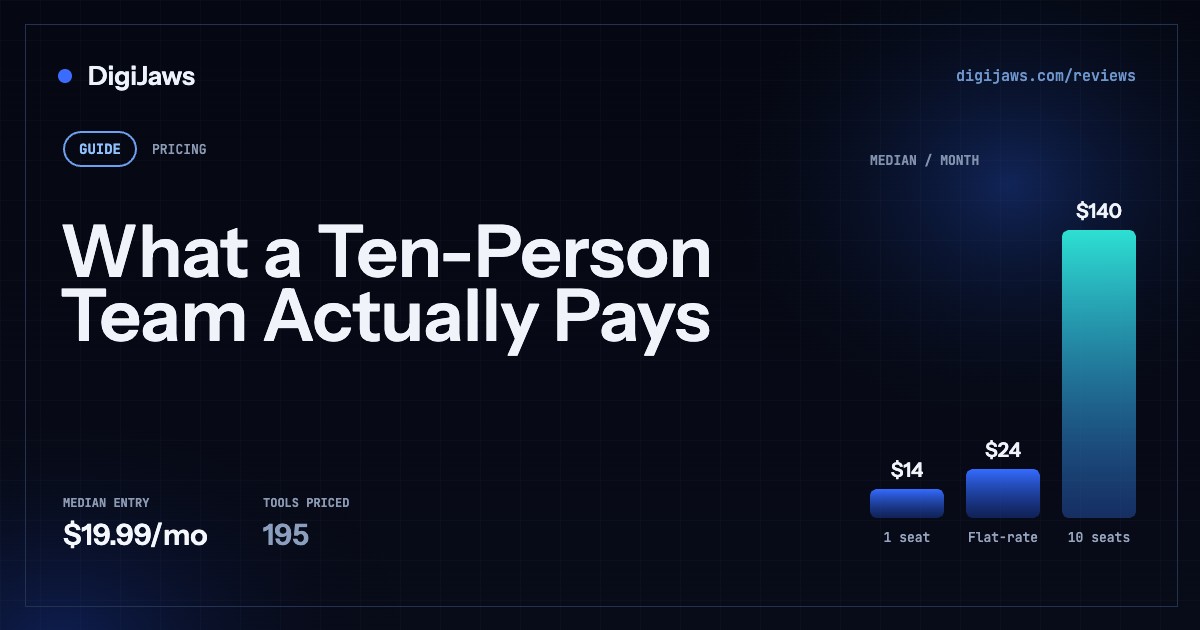
What a ten-person team actually pays
Software pricing pages are written for one person. Almost nobody buys software for one person. Across the 195 tools whose monthly price the vendor publishes, the median entry plan is $19.99. That number survives contact with reality for exactly as long as you have one employee. The two curves 59 of those tools charge per…
-
 Pricing
The software that will not tell you the price
Open rippling.com/pricing and you will not find a price. Not a range, not a starting-from, not a footnote. You will find a form: work email, company name, headcount band, phone number. We read the whole page. Zero currency figures. The FAQ does not have one either. 27 of the 302 business software tools we price-check…
-
 Pricing
Per-seat or flat: the pricing model that decides what your stack costs at ten people
Two tools sit next to each other in our dataset. Trello’s entry price is $5. Gusto’s is $6. Sorted by that column, Gusto is the more expensive of the two by a single dollar. In practice, for a team of ten, Gusto costs roughly twice what Trello does — and for a team of one,…
-
 Guide
Which software categories still give you a free tier — and which quietly stopped
172 of the 302 tools we track offer free or limited free access. 57% — a reassuring number that falls apart the moment you split it by category. In some categories nearly every product will let you in for nothing. In others, essentially none will. The dividing line is not generosity; it is whether the…
-
 Guide
What 302 business tools actually charge to get started
Every vendor on earth describes its pricing as competitive. Almost none of them say competitive with what. So here is the distribution they are all implicitly claiming to sit inside, built from the 302 tools we price-check and keep under version control. The median entry price for business software in 2026 is $19.99 a month.…
-
 Pricing
The AI visibility tax: the category selling AI search help is the most expensive in software
Here is a comparison worth sitting with. The tool that tells you whether ChatGPT mentions your brand will, in the median case, cost you more than your CRM, your email platform and your entire design stack combined. That is not a rhetorical flourish. We track published entry pricing for 302 business software tools, every figure…
-
 Guide
Is Your Website Ready for AI Search? Free Audit + 11-Point Checklist
Check whether AI engines can find, parse, and trust your site with this 11-point AI-readiness checklist and a free scan. Average site scores just 58/100.
-
 Guide
What Is llms.txt and How to Create One (With Examples)
llms.txt is a plain-text file that tells AI models what your site is and where its key content lives. What it is, why it matters, and how to create one.
-
 Guide
How to Rank in ChatGPT, Perplexity & Google AI Overviews
The 2026 playbook for getting cited in ChatGPT, Perplexity, and Google AI Overviews, with first-party data on what most sites get wrong.
-
 Guide
The Power of Data-Driven Marketing
TL;DR Data-driven marketing means making budget and campaign decisions from evidence rather than gut feel — and businesses that do it consistently outperform those that don’t. The core moves: test hypotheses instead of assuming, measure outcomes over activity, segment your audience (segmented campaigns beat broad ones by 2–5×), use predictive analytics to flag likely churn…